

"At a distance it presents a handsome appearance, being castle-like with towers at its angles... the design...answering all purposes of protection, defense, and as a residence." George R. Gibson, a soldier who visited the fort in 1846.

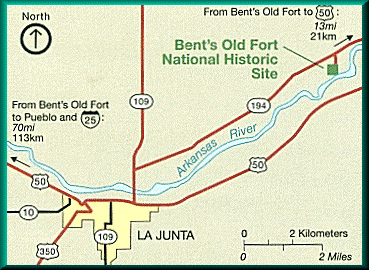
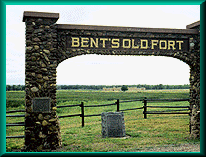 From La Junta, an interesting quick detour off US-50, Hwy-194 runs along
the north bank of the Arkansas River to one of Colorado's most evocative
historic sites, Bents Old Fort (daily 8 AM – 5:30 PM in summer, 9 AM
– 4:30 PM in winter; $2). It lies eight miles east of La Junta, or
15 miles west of Las Animas. Historic DAR Markers welcome you to begin your
journey back time at Bent's Old Fort National Historic Site. Before the
National Park Service acquired Bent's Old Fort in 1963 this was the entrance
to the Fort ruins. Erected by the La Junta Chapter, Daughters of the American
Revolution, while the chapter still owned the land, this gateway has two
inscriptions. On the left pillar: "Erected by LA JUNTA CHAPTER DAR
DEDICATED JUNE 14, 1930." On the right pillar: "BENT'S OLD FORT
." The DAR insignia is below this inscription. The center
Marker was originally placed on the ground of Bent's Old Fort. It was erected
at the request of the DAR in 1910 by A. E. Reynolds. Reynolds, owner of
the land donated the site of the Old Fort to the La Junta DAR Chapter in
1920. The dedication of the Marker took place September 5, 1912. The Marker
has been moved twice by the National Park Service, first to a contact station,
then in October 1984, to a site under the old gateway entrance which was
closed to traffic.
From La Junta, an interesting quick detour off US-50, Hwy-194 runs along
the north bank of the Arkansas River to one of Colorado's most evocative
historic sites, Bents Old Fort (daily 8 AM – 5:30 PM in summer, 9 AM
– 4:30 PM in winter; $2). It lies eight miles east of La Junta, or
15 miles west of Las Animas. Historic DAR Markers welcome you to begin your
journey back time at Bent's Old Fort National Historic Site. Before the
National Park Service acquired Bent's Old Fort in 1963 this was the entrance
to the Fort ruins. Erected by the La Junta Chapter, Daughters of the American
Revolution, while the chapter still owned the land, this gateway has two
inscriptions. On the left pillar: "Erected by LA JUNTA CHAPTER DAR
DEDICATED JUNE 14, 1930." On the right pillar: "BENT'S OLD FORT
." The DAR insignia is below this inscription. The center
Marker was originally placed on the ground of Bent's Old Fort. It was erected
at the request of the DAR in 1910 by A. E. Reynolds. Reynolds, owner of
the land donated the site of the Old Fort to the La Junta DAR Chapter in
1920. The dedication of the Marker took place September 5, 1912. The Marker
has been moved twice by the National Park Service, first to a contact station,
then in October 1984, to a site under the old gateway entrance which was
closed to traffic.
 Originally conceived simply as a trading post for mountain trappers'
beaver furs and Indians' buffalo robes, Bent's Old Fort soon became the
point of supply, the social center, the place of refuge and safety, the
rest and relaxation point for every white man and many Indians on the plains
and in the mountains. It was almost a second home to many of the West's
most famous mountain men, scouts, and Indian fighters, including the illustrious
Kit Carson.
Originally conceived simply as a trading post for mountain trappers'
beaver furs and Indians' buffalo robes, Bent's Old Fort soon became the
point of supply, the social center, the place of refuge and safety, the
rest and relaxation point for every white man and many Indians on the plains
and in the mountains. It was almost a second home to many of the West's
most famous mountain men, scouts, and Indian fighters, including the illustrious
Kit Carson.
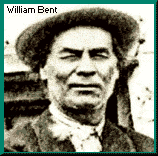
From 1833, when it was built by the fur traders William and Charles Bent, until 1848, when war with Mexico and increasing unrest among the local Arapaho, Apache, and Cheyenne tribes put an end to their business, Bent's Fort was the Southwest's most important outpost of white civilization and a stopping place for travelers, trappers, and explorers, including John C. Fremont, Francis Parkman, and just about every other Wild West luminary.
In 1833, the three Bent brothers and their business partner, Ceran St. Vrain, built what was to become a commercial hub of civilization whose influence and magnetic pull was felt throughout the High Plains and the Central Rockies and whose name has become legendary, "Bent's Old Fort."
Bent's Fort had its hey day from 1833 when it was built by the fur traders William and Charles Bent until 1848. The following excerpts are from "Dr. Colorado" from the Pueblo Chieftain, 3/8/03. The article can be read in its entirety at
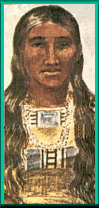 "Bent's Fort welcomed all of the people along the Santa Fe Trail,
Indians and soldiers, Mexicans, Germans, French, Irish and blacks. All were
wined and dined by the Bents and their black cook, Charlotte. It was first
named Fort William after its construction supervisor who was the resident
manager along with his Cheyenne wife, Owl Woman. The fort traded with the
nearby Cheyenne, Arapaho, Arikara, Comanche, Kiowa, Shoshone and Sioux Native
Americans. The Fort promoted free trade, free talk and even inter-marriage
among peoples who would later war violently on each other. William grew
frustrated with the U.S. government's failure to compensate him for housing
and supplying Mexican and Indian War troops. One warm August day in 1849,
he cleared the fort of his family, friends and possessions, and set fire
to the wooden roof and lighted a fuse to the gun powder room, blasting the
Camelot of the high plains into oblivion. He built a new Fort, but it never
approached the fame or status of the original. In 1859, William sold it
to the U.S. Army, which renamed it Fort Lyon."
"Bent's Fort welcomed all of the people along the Santa Fe Trail,
Indians and soldiers, Mexicans, Germans, French, Irish and blacks. All were
wined and dined by the Bents and their black cook, Charlotte. It was first
named Fort William after its construction supervisor who was the resident
manager along with his Cheyenne wife, Owl Woman. The fort traded with the
nearby Cheyenne, Arapaho, Arikara, Comanche, Kiowa, Shoshone and Sioux Native
Americans. The Fort promoted free trade, free talk and even inter-marriage
among peoples who would later war violently on each other. William grew
frustrated with the U.S. government's failure to compensate him for housing
and supplying Mexican and Indian War troops. One warm August day in 1849,
he cleared the fort of his family, friends and possessions, and set fire
to the wooden roof and lighted a fuse to the gun powder room, blasting the
Camelot of the high plains into oblivion. He built a new Fort, but it never
approached the fame or status of the original. In 1859, William sold it
to the U.S. Army, which renamed it Fort Lyon."
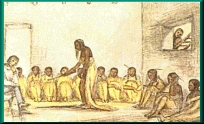 When Bent brothers, St. Vrain & Company planned the new fort, the
area offered little in lumber. They turned to adobe as an alternative. Adobe
was made of clay, water and sand with straw or wool used as a binding agent
and mixed in pits. The 18"x9"x4" bricks were poured into
forms and dried in the sun. With regular maintenance they proved to be durable
in the dry climate. This multi cultural center offered work for many Mexican
laborers and a neutral ground for peace talks for the Indian peace councils.
This casual environment led to an occasional intermarriage and easy mixing
of groups at dances and the work environment, but normally drinking and
gambling did not include Indians and Mexican laborers. The owners had their
private dining area for their special guests, and everyone else cooked in
their quarters or ate from a community cooking pot. Social distinctions
became apparent at nightfall when the owners retired to their quarters,
the craftsmen slept where they worked, the Indians slept outside the fort
at the camps on the Arkansas River, the fur trappers and hunters stayed
in their quarters, and the Mexican laborers in the laborer quarters.
When Bent brothers, St. Vrain & Company planned the new fort, the
area offered little in lumber. They turned to adobe as an alternative. Adobe
was made of clay, water and sand with straw or wool used as a binding agent
and mixed in pits. The 18"x9"x4" bricks were poured into
forms and dried in the sun. With regular maintenance they proved to be durable
in the dry climate. This multi cultural center offered work for many Mexican
laborers and a neutral ground for peace talks for the Indian peace councils.
This casual environment led to an occasional intermarriage and easy mixing
of groups at dances and the work environment, but normally drinking and
gambling did not include Indians and Mexican laborers. The owners had their
private dining area for their special guests, and everyone else cooked in
their quarters or ate from a community cooking pot. Social distinctions
became apparent at nightfall when the owners retired to their quarters,
the craftsmen slept where they worked, the Indians slept outside the fort
at the camps on the Arkansas River, the fur trappers and hunters stayed
in their quarters, and the Mexican laborers in the laborer quarters.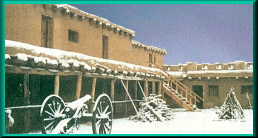
They include:
 Winter Quarters - Daily winter activities including the Mountain Man
Rendezvous, a fur traders' roundup.
Winter Quarters - Daily winter activities including the Mountain Man
Rendezvous, a fur traders' roundup.
Independence Day - Fourth of July celebration reflecting the 1830s and
demonstration of the Native American role in the fort's activities.
Kid's Quarters - Annual event that teaches kids what life was like in
the 1840's.
Founders Day - Celebration of the founding of the National Park Service.
Traditional Holiday Celebration - Holiday celebration of the 1830's
including a look at traditional Mexican Christmas celebrations of that era.
 Bent’s Fort and Sand Creek Tour!
Saturday, May 29, 2004, 9 A.M. to Sunday, May 30, 4 P.M.
Meet at the Colorado History Museum, 1300 Broadway, Denver
Join David Fridtjof Halaas and Andrew Masich, authors of the newly released Halfbreed: The Remarkable True Story of George Bent, Caught Between the Worlds of the Indian and the White Man for a tour of Bent’s Old Fort, Bent’s New Fort, and the Sand Creek Massacre site.
Tour participants will board a bus Saturday morning at the Colorado History
Museum. A visit to the newly remodeled El Pueblo History Museum in Pueblo,
Colo. will be the first stop. The tour will continue to Bent’s Old
Fort, Boggsville, Fort Lyon and the Old Fort Wise/Fort Lyon site. The group
will spend the night in Lamar at the Best Western Cow Palace Inn. A buffet
dinner with speakers will be offered on Saturday night. The group will arrive
at the Sand Creek site the Sunday morning and hear about the latest developments
in making this site a national historic park. After leaving Sand Creek,
the group will enjoy a boxed lunch while Halaas and Masich discuss the culture
of native peoples and nearby historic sites. The tour will return to Denver
by 4 P.M. Cost, $325 for members and $375 for nonmembers (single supplement
$50), includes bus, one night’s lodging (double occupancy), and all
entrance and interpretation fees.

 Calender
Contact Name: Greg Holt | Rick Wallner or .
June 12, 2004 - KID'S QUARTERS
Time: 9:00 AM to 12:00 PM
Seven to eleven year old children are invited to "step back in time"
and learn skills of the 1800s. Children experience life as a trapper, trader,
laborer, craftsman, Indian or soldier. Pre-registration and fee required
for children participants. Applications available by calling.
August 1-3 - SANTA FE TRAIL ENCAMPMENT,
Time: Jul 30- August 1, 2004
During this same week in history in 1846, the "Army of the West"
arrived at Bent's Fort destined for war with Mexico. Living historians will
portray the roles of the U.S. Army, Bent's Fort employees, Santa Fe Trail
merchants and Plains Indians. Demonstrations will include camp life, military
drills, 19th century frontier cooking, black smiting, carpentry, livestock
use, trading techniques, and vignettes.
December 5-6 - TRADITIONAL HOLIDAY CELEBRATION
Time: December 3-4, 2004 .
The Yule tide spirit comes alive with candlelight tours, wagon rides, Yule
log hunt, games, frontier cooking, storytelling and toy making. The holiday
merriment will interrupt the regular fort fur trading routine. Witness for
yourself the joys, pleasures and past times of the 1840s at this isolated
trading post.
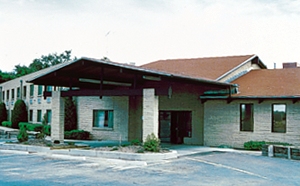
For overnight accommodations before your journey begins or at the end of your trek stay at Best Western Bent's Fort Inn, East US 50, Las Animas, CO US 81054.
Site Map |
La Junta Sites |
Lamar Sites |
Trinidad Sites |
Byway Museums |
Byway Events |
Byway Links |
