
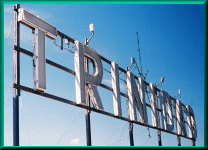
 Trinidad is rightfully referred to as the gateway to the Mountain Route
of the Santa Fe Trail. Carefully guarding this passageway, one finds a great
sentinel, an historic sandstone bluff, Simpson's Rest, standing proudly
at Trinidad's northern limits. The mountain proudly adorns the Trinidad
sign which lights up the evening skies and serves as a becon to modern day
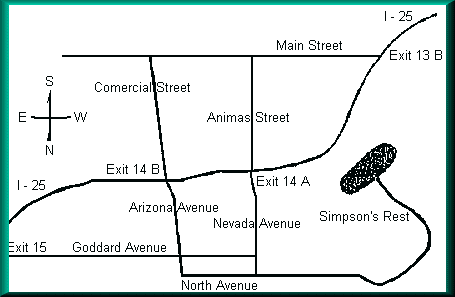
trail travelers. The bluff, overlooking the town from the north can be reached
by way of a road leading from the western end of North Avenue.
Trinidad is rightfully referred to as the gateway to the Mountain Route
of the Santa Fe Trail. Carefully guarding this passageway, one finds a great
sentinel, an historic sandstone bluff, Simpson's Rest, standing proudly
at Trinidad's northern limits. The mountain proudly adorns the Trinidad
sign which lights up the evening skies and serves as a becon to modern day
trail travelers. The bluff, overlooking the town from the north can be reached
by way of a road leading from the western end of North Avenue.
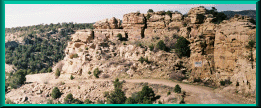 Visitors may access the top by car to view his Simpson's grave marker
and a spectacular view of the city. Open 8:00 AM until sundown daily. Please
respect our Cities historic monuments and do not deface this site. We appreciate
your respect for one of our most valuable historic treasures. The road is
very steep and not maintained. It has very low clearance in some areas,
so be very careful.
Visitors may access the top by car to view his Simpson's grave marker
and a spectacular view of the city. Open 8:00 AM until sundown daily. Please
respect our Cities historic monuments and do not deface this site. We appreciate
your respect for one of our most valuable historic treasures. The road is
very steep and not maintained. It has very low clearance in some areas,
so be very careful.

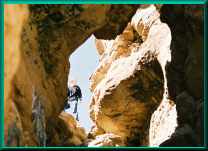 Buried atop the Rest is Trinidad pioneer George S. Simpson, one of this
areas true "trail blazers." Simpson was a famous scout, trader,
and explorer. Born in St. Louis, Missouri, in 1818, Simpson first came to
this area in 1848. Years later, the prominent pioneer settled here. While
engaging in different enterprises, he was elected in 1861 as this regions
first territorial county clerk. There are as many stories about the Simpson
Indian attack as there are imaginations. The most common elements of these
stories are that in 1867, prior to Trinidad becoming incorporated, Simpson
was along the banks of the Purgatoire River when he was confronted by warring
Ute Indians. Simpson fled up a nearby butte and hid inside one of the natural
vertical crevices that were found in this sandstone bluff.
Buried atop the Rest is Trinidad pioneer George S. Simpson, one of this
areas true "trail blazers." Simpson was a famous scout, trader,
and explorer. Born in St. Louis, Missouri, in 1818, Simpson first came to
this area in 1848. Years later, the prominent pioneer settled here. While
engaging in different enterprises, he was elected in 1861 as this regions
first territorial county clerk. There are as many stories about the Simpson
Indian attack as there are imaginations. The most common elements of these
stories are that in 1867, prior to Trinidad becoming incorporated, Simpson
was along the banks of the Purgatoire River when he was confronted by warring
Ute Indians. Simpson fled up a nearby butte and hid inside one of the natural
vertical crevices that were found in this sandstone bluff.
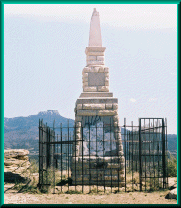 The attacking Indians did not locate Simpson and after three or so days,
Simpson emerged from his hiding spot, thankful to the rock for his life.
Later in life he wrote a poem about his desire to be buried there. This
of course is but part of Simpson's contributions toward settling the West.
Added to the 1866 Indian escapade, is the fact that he helped establish
the Ft. Pueblo Trading Post and is credited with the first discovery of
gold in Colorado, leading to the famous 1859 Rush to the Rockies. Years
before his death, Simpson requested burial atop his beloved Rest, and his
wish was honored in 1885. In September of 1885 it became his final resting
place.
The attacking Indians did not locate Simpson and after three or so days,
Simpson emerged from his hiding spot, thankful to the rock for his life.
Later in life he wrote a poem about his desire to be buried there. This
of course is but part of Simpson's contributions toward settling the West.
Added to the 1866 Indian escapade, is the fact that he helped establish
the Ft. Pueblo Trading Post and is credited with the first discovery of
gold in Colorado, leading to the famous 1859 Rush to the Rockies. Years
before his death, Simpson requested burial atop his beloved Rest, and his
wish was honored in 1885. In September of 1885 it became his final resting
place.
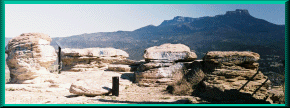 The summit of Simpson's Rest offers one of the most spectacular awe-inspiring
views to be found in the entire southwest. Not to drive atop the Rest, is
not to see Trinidad. The bold magnificent Rest in itself represents a geological
Mecca. Time and the forces of nature have combined to reveal centuries of
sedimentary deposits that have graciously formed into a sandstone outcroppings
defying description.
The summit of Simpson's Rest offers one of the most spectacular awe-inspiring
views to be found in the entire southwest. Not to drive atop the Rest, is
not to see Trinidad. The bold magnificent Rest in itself represents a geological
Mecca. Time and the forces of nature have combined to reveal centuries of
sedimentary deposits that have graciously formed into a sandstone outcroppings
defying description.
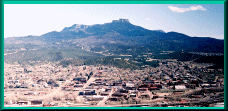 Here one can observe tenacious layers of strata meticulously placed
atop one another long before recorded history. The area abounds with fossilized
remains of pre-historic forms of life entrapped within the strata. The artistically
hewn sandstone has formed into a great semi-elliptical sheer cliff. From
its curved edges, the visitor is afforded an unsurpassable panoramic view
of a valley perhaps among the most outstanding of the Southwest. Directly
north of the cliff, visitors can stroll through gently carved sandstone
cavernous formations, partaking in a visual observation of the giant canvass
of the Master artist of the times.
Here one can observe tenacious layers of strata meticulously placed
atop one another long before recorded history. The area abounds with fossilized
remains of pre-historic forms of life entrapped within the strata. The artistically
hewn sandstone has formed into a great semi-elliptical sheer cliff. From
its curved edges, the visitor is afforded an unsurpassable panoramic view
of a valley perhaps among the most outstanding of the Southwest. Directly
north of the cliff, visitors can stroll through gently carved sandstone
cavernous formations, partaking in a visual observation of the giant canvass
of the Master artist of the times.
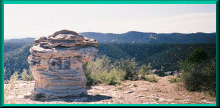 Once atop Simpson's Rest one is afforded an undisturbed view of the
historic Purgatoire Valley. This fertile valley abounds with both natural
and man made landmarks. Most prominent of the landmarks is Fisher's Peak,
protruding upward to form a great natural southern border nestling the valley
far below, this breathtaking mesa is considered as one of the most outstandingly
well preserved massive lava flows found on the North American continent.
Looking to the southwest of Trinidad, one sees the Purgatoire River dam,
retaining the 800 acre Trinidad Lake. This lake allows for the 2300 acre
Trinidad State Recreation Area. To the west of the dam, stands the bold,
rugged Sangre De Cristo Mountain Range, a portion of the famed Rocky Mountains.
The northern most point of the Range features the tops of historic Spanish
Peaks.
Once atop Simpson's Rest one is afforded an undisturbed view of the
historic Purgatoire Valley. This fertile valley abounds with both natural
and man made landmarks. Most prominent of the landmarks is Fisher's Peak,
protruding upward to form a great natural southern border nestling the valley
far below, this breathtaking mesa is considered as one of the most outstandingly
well preserved massive lava flows found on the North American continent.
Looking to the southwest of Trinidad, one sees the Purgatoire River dam,
retaining the 800 acre Trinidad Lake. This lake allows for the 2300 acre
Trinidad State Recreation Area. To the west of the dam, stands the bold,
rugged Sangre De Cristo Mountain Range, a portion of the famed Rocky Mountains.
The northern most point of the Range features the tops of historic Spanish
Peaks.
 An outstanding feature of Colorado's front range is the opportunity
to witness the abrupt topographical change. Simpson's Rest, in terms of
accessibility and location, is perhaps unsurpassable for allowing visitors
the opportunity to perceive the rapid dramatic change from hills and mountains
to rolling prairies. Those prairies directly to the east are most notable,
for it was here that pioneers and traders traveled across what became known
as the Santa Fe Trail. Eventually, this trail wound through the heart of
downtown Trinidad before embarking across mountainous Raton Pass.
An outstanding feature of Colorado's front range is the opportunity
to witness the abrupt topographical change. Simpson's Rest, in terms of
accessibility and location, is perhaps unsurpassable for allowing visitors
the opportunity to perceive the rapid dramatic change from hills and mountains
to rolling prairies. Those prairies directly to the east are most notable,
for it was here that pioneers and traders traveled across what became known
as the Santa Fe Trail. Eventually, this trail wound through the heart of
downtown Trinidad before embarking across mountainous Raton Pass.
Site Map |
La Junta Sites |
Lamar Sites |
Trinidad Sites |
Byway Museums |
Byway Events |
Byway Links |
